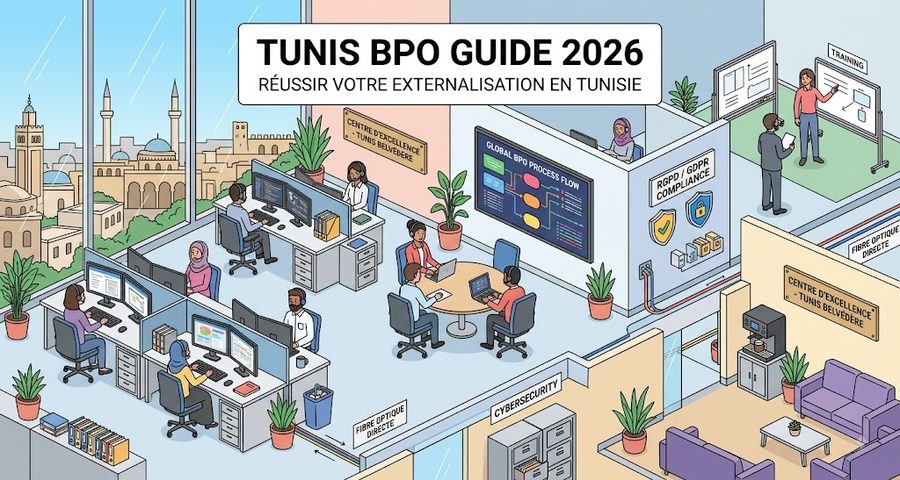
Facing rising salary costs in Europe and persistent difficulty recruiting bilingual customer service profiles, Tunisia has established itself durably in the French-speaking outsourcing landscape. But the reasoning has changed in nature.
In 2026, an outsourcing decision based purely on hourly rate differences is very likely to fail. Projects that last are those treating outsourcing as a question of access to a skills pool and capacity to scale — with cost being just one variable.
1. Why Tunisia, concretely
French language and cultural proximity
French is taught from primary school and remains the language of scientific higher education and large parts of economic life. For customer service, this changes everything: understanding the implied meanings, politeness conventions and cultural references of a French or Belgian customer is not something learned in three weeks of training.
Time zone
Tunis is on GMT+1. Your outsourced teams work the same hours as your internal ones, removing lag in escalations, daily stand-ups and incident resolution. It is an operational advantage consistently underestimated relative to more distant destinations.
Physical proximity
Two and a half hours by plane from Paris. That sounds anecdotal until the day you need to send a project manager to launch a campaign, audit a floor or unblock a situation. A destination you can visit within the day is managed differently from one eleven hours away.
Education pipeline
The country produces a substantial volume of higher education graduates each year, with a notable proportion of technical and management profiles. For activities beyond simple call handling — level 1 and 2 technical support, specialised back-office, moderation — this is the determining factor.
2. What outsourcing actually costs
The advertised hourly rate never represents a project's full cost. Here are the items to include in your comparison to avoid unpleasant surprises in year two.
| Cost item | Often forgotten? | Comment |
|---|---|---|
| Hourly rate per position | No | The visible part, usually well negotiated |
| Initial training | Yes | Two to six weeks depending on complexity |
| Ramp-up cost | Yes | Full productivity is not reached on day one |
| Client-side management | Often | A dedicated internal contact is required, and not free |
| Software and telephony licences | Sometimes | Check who pays per-seat CRM licences |
| Cost of attrition | Almost always | Each departure restarts the training cycle |
| Audits and compliance | Often | Security audit, contractual clauses, DPA |
3. GDPR compliance and data security
This is where legal departments most often block, and legitimately so. Tunisia is a third country under GDPR: it does not benefit from a European Commission adequacy decision. That does not make transfer impossible, but it must be framed.
The framework to put in place
- Standard Contractual Clauses (SCCs). The most widely used transfer mechanism. They must be signed in their current version and adapted to the actual processing setup.
- Transfer impact assessment. A documented evaluation of the destination country's legal context and the compensating measures in place.
- Data processing agreement (DPA). Specifying purposes, retention periods, sub-processors and breach notification procedures.
- Technical measures. Encryption in transit and at rest, access segregation on a least-privilege basis, logging, clean desk policy, locked workstations without local storage.
- Local framework. Tunisia has its own data protection authority, the INPDP, with declaration obligations to meet on the Tunisian side.
4. Recruitment and retention: the real risk factor
Most disappointing outsourcing projects do not collapse suddenly. They degrade slowly, as trained agents leave and are replaced by less experienced profiles. Quality at month six bears no resemblance to the pilot phase.
The levers that genuinely work:
- Select on aptitude, not just the CV. Standardised assessment of stress resilience and empathy predicts success better than a diploma.
- Create progression paths. An agent who sees a route to supervisor, trainer or quality specialist stays longer.
- Size the team correctly from the start. A chronically understaffed team burns out, and burnout produces departures, which worsens understaffing.
- Involve teams in the product. An agent who understands what they sell or troubleshoot is more effective and more engaged than one reciting a script.
5. Managing quality: the metrics that matter
An outsourcing contract without contractualised metrics is a guaranteed source of disagreement. Here is the minimum baseline to define before go-live.
| Metric | What it measures | Pitfall to avoid |
|---|---|---|
| Answer rate / service level | Service accessibility | Can be optimised at the expense of handling quality |
| First contact resolution | Real effectiveness | Define precisely what counts as "resolved" |
| CSAT / customer satisfaction | End customer perception | Beware respondent selection bias |
| Average handling time | Productivity | Reducing it alone degrades every other metric |
| Quality compliance score | Procedure adherence | Requires a shared, calibrated scorecard |
| Attrition rate | Team health | A leading indicator, often absent from contracts |
6. The five most common mistakes
- Choosing on price alone. The gap between two providers is wiped out by one quarter of poor service quality.
- Outsourcing an undocumented process. If your procedures are not written down, outsourcing will not clarify them — it will expose the problem.
- Not assigning an internal owner. A project without a client-side contact drifts within weeks.
- Starting too big. A pilot of five to ten positions reveals the problems at a bearable cost.
- Leaving compliance until signature. Discovering GDPR requirements the day before go-live delays projects by months.
7. Provider selection checklist
The questions worth asking in a meeting, where the answers are genuinely discriminating:
- What is your annual attrition rate, and will you write it into the contract?
- Can you show me the floor and let me speak to agents without prior preparation?
- What is your continuity procedure in the event of a network or power outage?
- Who are your sub-processors and where is the data hosted?
- What is the initial training path, and who bears the cost?
- How do you handle an unexpected 30% activity spike?
- Can I speak to a current client on a scope comparable to mine?