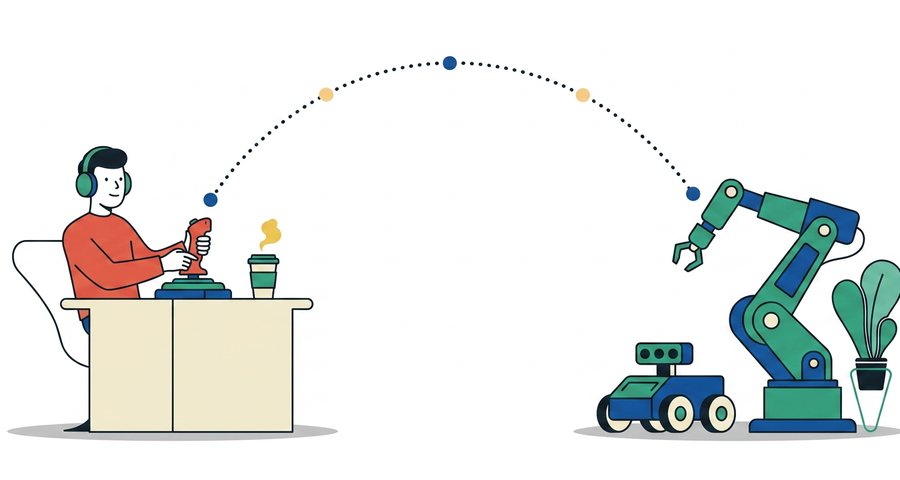
The principle
On-site automation works well right up to the point where it doesn't. An unexpected obstacle, a badly positioned parcel, an anomaly the model has never encountered: the robot stops and someone has to walk over. Those interruptions often account for a disproportionate share of total operating cost.
Teleoperation addresses exactly that. The robot stays with you and handles most of its mission alone. As soon as it hits an edge case, a trained operator takes over remotely, in real time, then hands control back to autonomy. You are not paying for a full-time pilot per machine — you are buying access to pooled supervision capacity.
Applications covered
- Material-handling and logistics robots. Remote takeover in congested areas, on badly stacked pallets and after failed picks in warehouses.
- Technical inspection drones. Roof, façade, solar panel and infrastructure surveys, with one expert pilot shared across multiple sites.
- Security and patrol robots. Securing industrial sites outside working hours, with human qualification of alerts to eliminate false alarms.
- Service and reception robots. Handling the interactions the conversational layer cannot resolve.
- Retail inventory and shelf inspection. Piloting scanners to detect stockouts and labelling errors.
The infrastructure behind the service
| Component | Configuration |
|---|---|
| Connectivity | Dual-homed fibre, two separate carriers, automatic failover |
| Network route | Direct link to Marseille, a major Southern European exchange point |
| Pilot stations | High refresh-rate displays, dedicated controllers, low-latency video encoding |
| Power | UPS units and backup generator |
| Security | Controlled physical access, Zero-Trust architecture, session logging |
| Monitoring | NOC with continuous latency and availability monitoring |
Our operator profile
Teleoperation quality depends more on the operator than on the network. Human reaction time — roughly 200 to 250 milliseconds — far exceeds transmission latency. Optimising the network without selecting the right people produces no measurable effect.
Our operators are recruited on standardised aptitude assessment: visuospatial perception, trajectory anticipation, simultaneous management of multiple information streams, and stability under pressure. These skills do not show up on a CV. We measure them, including on a simulator before hiring.
Start with a measured pilot
We never propose a full-scale deployment without a measurement phase first. The pilot exists to produce numbers, not to convince you.
- Week 1 — Technical qualification. Measuring real latency between your site and our floor, bandwidth audit, and verification that your hardware supports remote control.
- Weeks 1–2 — Edge case scoping. Identifying and counting the situations that currently trigger an on-site human intervention. That volume determines your return on investment.
- Weeks 3–6 — Supervised pilot. One or two dedicated operators trained on your equipment, with daily tracking of takeover rate, intervention duration and remote resolution rate.
- Week 7 — Decision on data. Comparing cost per remote intervention against cost per on-site intervention. If the gap does not justify scaling up, we will tell you so.
What we do not promise
Teleoperation is not suited to everything, and telling you otherwise would cost us your trust within the first month.
- Tasks requiring fine force feedback — delicate handling, millimetre adjustment with tactile sensation — remain difficult remotely.
- Sites without reliable, redundant network coverage are not eligible: an unstable connection in teleoperation is a safety risk, not an inconvenience.
- Drone piloting falls under specific national and European regulations, to be reviewed case by case before any deployment.
- Physical maintenance stays local: batteries, dirty sensors and broken parts still require someone on site.